Modern marketing operations are increasingly complex and fragmented
More marketing specialists can mean more complexity. See what ANA, McKinsey, and Gartner reveal about the growing need for better coordination.

More marketing specialists can mean more complexity. See what ANA, McKinsey, and Gartner reveal about the growing need for better coordination.

Aug, 13, 2026
Modern businesses have access to more marketing channels, technologies, platforms, agencies, and specialized service providers than ever before.
This gives companies access to valuable expertise, but it also creates an operational challenge: more specialists, partners, and platforms must be coordinated around the same strategy, priorities, data, and business objectives.
Research from the Association of National Advertisers (ANA) and Millward Brown Vermeer identifies two connected developments:
As a result, companies need access to specialized expertise across areas such as strategy, advertising, content, creative production, data, technology, platforms, and performance measurement.
ANA also notes that as marketing becomes more complex, brands increasingly rely on a growing number of partners to help them connect with customers.
Specialization can improve access to expertise. However, it also increases the number of internal teams and external partners that must work together.
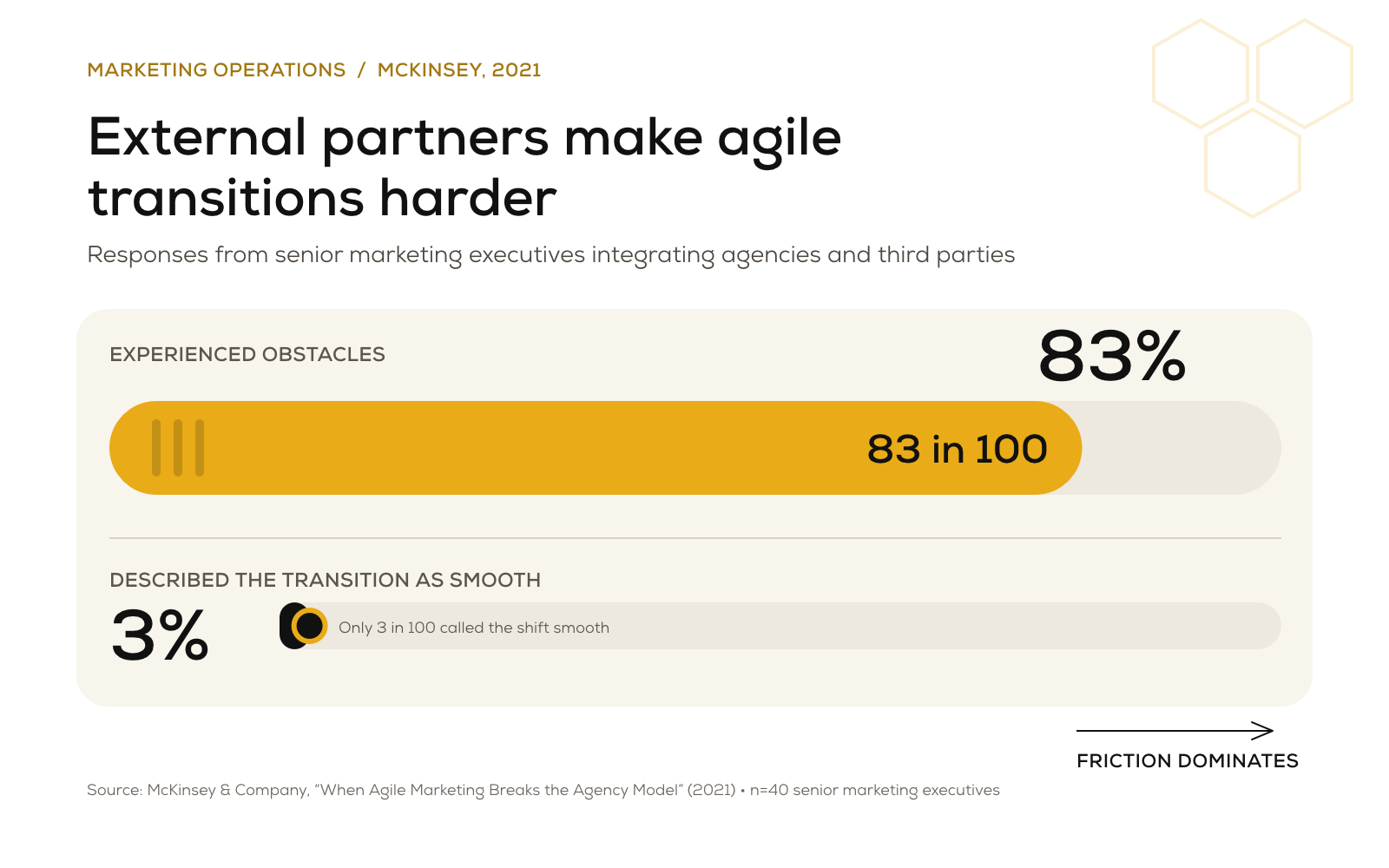
McKinsey & Company examined how senior marketing executives managed the transition to agile marketing while working with agencies and other third-party partners.
Only 3% of respondents described the transition as smooth.
A total of 83% rated the transition at three or lower on a five-point scale. This means that most respondents experienced at least some obstacles when integrating agencies and external partners into a faster and more collaborative marketing model.
McKinsey identifies several areas that can create difficulties:
McKinsey also states that managing multiple external partners can already be complicated in a traditional marketing department. The challenge becomes greater as companies coordinate not only agencies, but also technology platforms, publishers, measurement providers, and other third parties.
The finding does not mean that working with multiple agencies always fails. It shows that integrating different external partners into one connected marketing operation requires strong coordination, clearly defined responsibilities, aligned incentives, and shared performance measurement.
Gartner’s 2025 CMO Spend Survey found that marketing budgets remained unchanged at an average of 7.7% of company revenue.
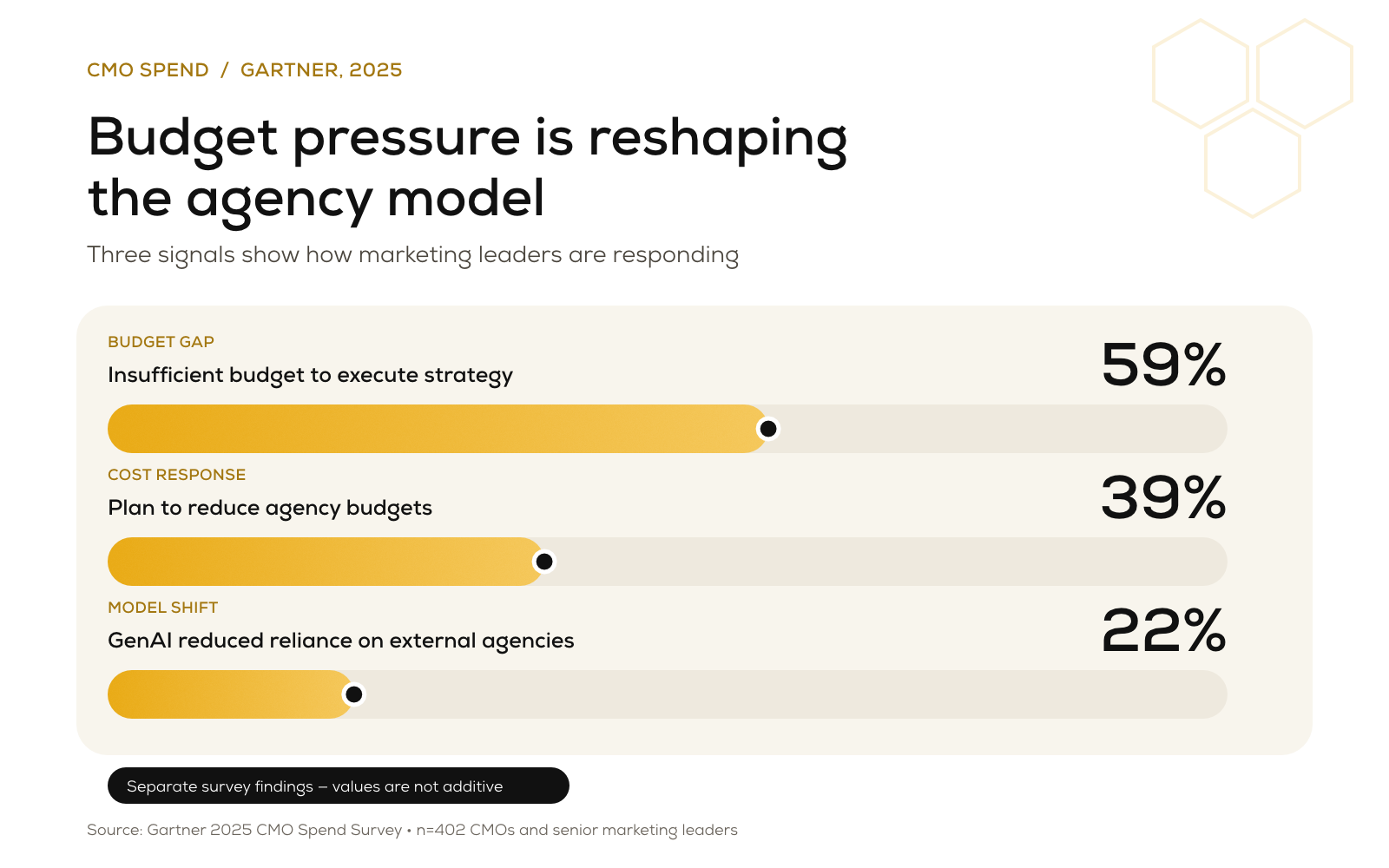
At the same time, 59% of CMOs reported that they did not have sufficient budget to execute their marketing strategy fully.
This pressure is pushing marketing leaders to improve productivity and review how they use agencies and external resources.
Gartner found that:
These findings do not suggest that companies no longer need external expertise.
They indicate that marketing leaders are becoming more selective about which external relationships create value, how responsibilities are divided, and how many partners they need to manage.
The focus is moving toward greater productivity, clearer accountability, and more efficient operating models.
The research identifies a broader operational challenge:
As marketing becomes more specialized, companies must coordinate an increasing number of people, capabilities, platforms, and external partners.
When these resources operate separately, businesses can experience:
Businesses do not need another disconnected marketing provider.
They need a trusted partner capable of bringing the required expertise together within one coordinated system.
Proactive Hive simplifies marketing operations through:
Instead of providing another isolated service, Proactive Hive identifies the company’s most important growth bottlenecks and organizes the necessary specialists around solving them.
The client does not need to independently manage separate agencies, freelancers, and service providers. Proactive Hive coordinates the strategy, specialists, execution, communication, and reporting through one connected operating model.
Businesses do not necessarily lack access to marketing agencies, freelancers, or specialized service providers.
The greater challenge is ensuring that all of these resources work together toward the same business objectives.
The market does not simply need more marketing providers. It needs better coordination, integration, and accountability.
Marketing2020 was a global marketing leadership research initiative led by Millward Brown Vermeer in partnership with the Association of National Advertisers, Spencer Stuart, and Adobe.
The wider Marketing2020 fieldwork included:
The research examined how companies align their marketing strategies, organizational structures, and capabilities to support business growth.
The ANA material supports the broader conclusions that marketing is becoming more technical, media is becoming more fragmented, and brands increasingly depend on specialized partners.
However, the publicly available summaries do not specify which part of the overall Marketing2020 sample was used for the findings about agency specialization and the growing number of partners.
The ANA findings should therefore be used as evidence of a broad industry trend rather than as a precise measurement of how many agencies an average company manages.
McKinsey conducted an online survey between June 25 and July 1, 2021.
The survey included:
Participants were asked how smooth or challenging the transition to agile marketing had been when agencies and third-party partners were included.
The findings relate specifically to integrating external partners into agile marketing operations. They should not be presented as evidence that every agency relationship or every multi-agency model is unsuccessful.
The sample also represents large organizations with substantial marketing budgets. The results may not directly represent the experience of every small or medium-sized business.
The Gartner 2025 CMO Spend Survey was conducted between February and March 2025.
The survey included:
The research examined marketing budgets, productivity priorities, technology investments, labor costs, and agency spending.
Its findings provide strong evidence that large organizations are reviewing agency relationships, reducing unproductive partnerships, and simplifying their agency rosters under budget and productivity pressure.
Because most respondents represented large organizations, the findings should be presented as evidence of a broader market direction rather than proof that every small or medium-sized business is following the same approach.